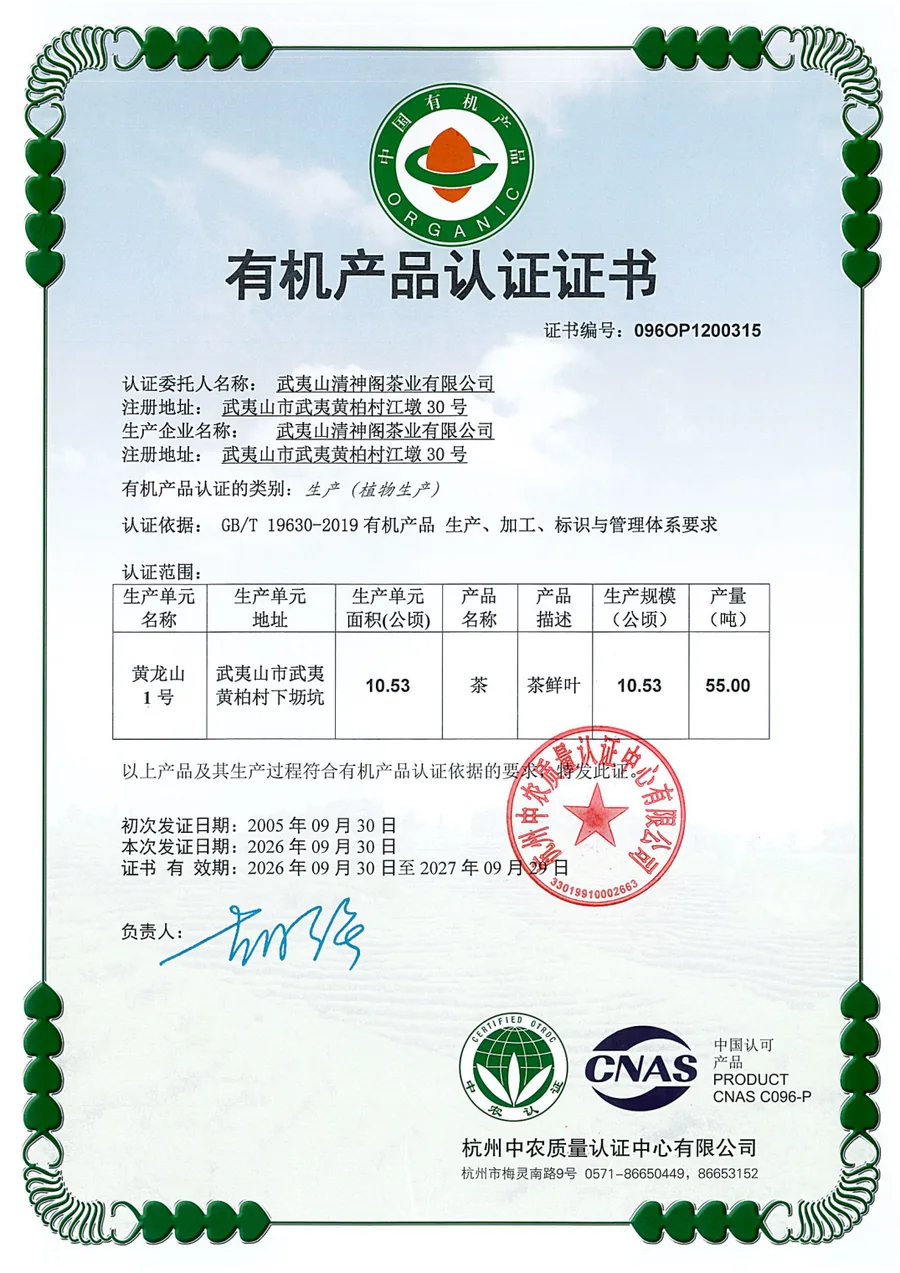
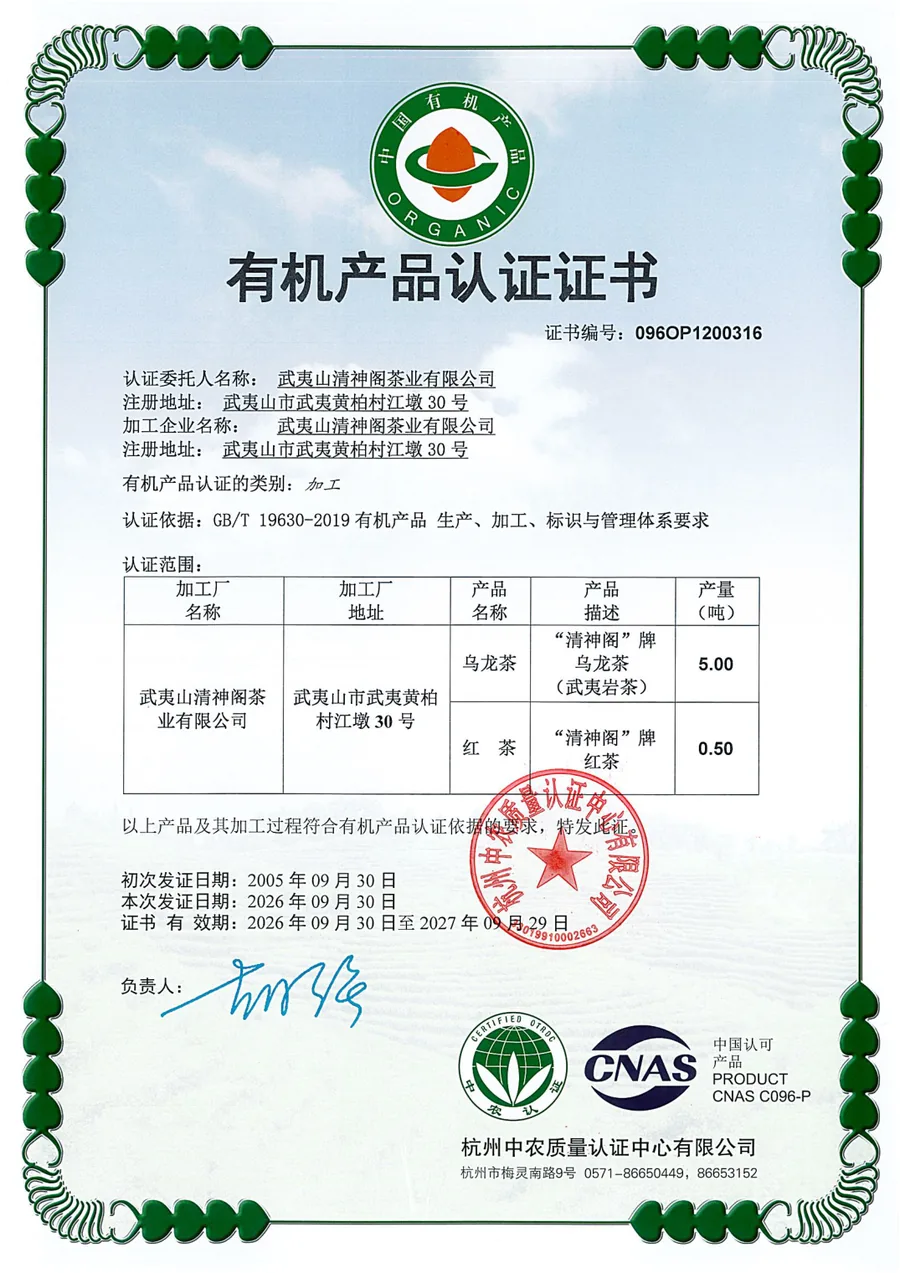
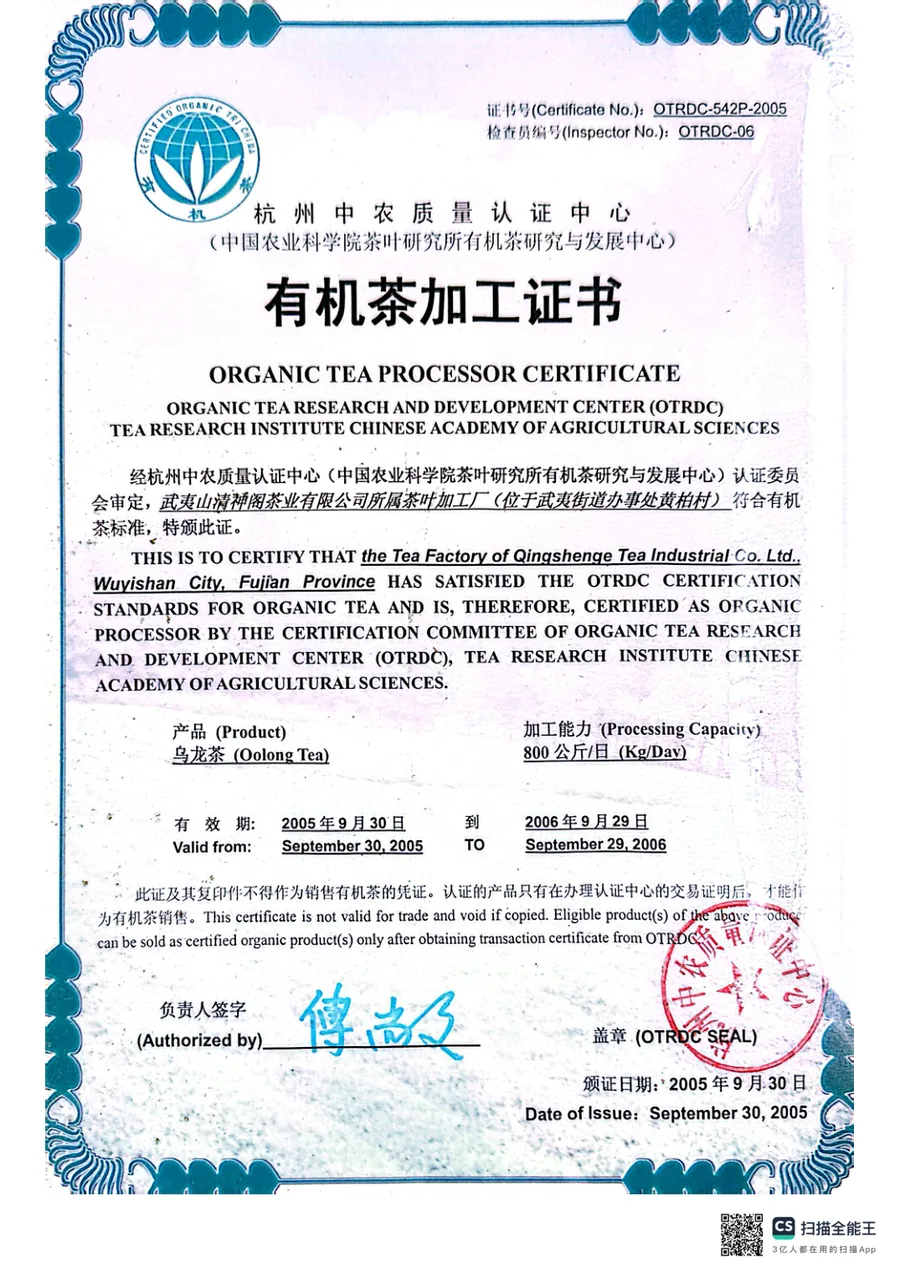
Kings Tea (Qingshenge) was first certified organic on 30 September 2005 under China's national organic standard. Its files hold twenty consecutive annual certificates, covering 30 September 2005 to 29 September 2025. The current certificates — 096OP1200315 for the garden and 096OP1200316 for processing — run from 30 September 2026 to 29 September 2027.
2005
2006
2007
2008
2009
2010
2011
2012
2013
2014
2015
2016
2017
2018
2019
2020
2021
2022
2023
2024
2005 · first certificate, valid from 30 September 20052024 · twentieth certificate, valid to 29 September 2025
A certificate covers a defined garden or product, for a defined period. Here are ours, with their scope written out in full.
Garden · fresh tea leaf
Certificate
096OP1200315
Garden
Huanglongshan No. 1 · 10.53 hectares
Valid
30 Sep 2026 – 29 Sep 2027 First issued 30 September 2005
Covers: fresh tea leaf from the garden named. Does not cover: other land associated with the company.
Processing · oolong & black tea
Certificate
096OP1200316
Products
Qingshenge-brand oolong tea (Wuyi rock tea) and black tea
Valid
30 Sep 2026 – 29 Sep 2027 First issued 30 September 2005
Covers: the listed products made at our factory. Does not cover: teas outside that scope — ask which teas and lots are certified.
Twenty years, one certificate at a time
The first certificate, and the twentieth.
Our first organic tea processing certificate was issued on 30 September 2005 by the Organic Tea Research and Development Center (OTRDC) of the Tea Research Institute, Chinese Academy of Agricultural Sciences — today Hangzhou Zhongnong Quality Certification Centre.
Organic certification in China is renewed every year. We keep every certificate: twenty in a row from 2005 to 2024, each starting the day after the last one ended. The newest pair, issued 30 September 2026, still prints the same first-issue date.
Our first organic tea processing certificate, valid 30 September 2005 – 29 September 2006.
How we farm
No shortcuts in the garden.
Organic certification sets the rules. These are the practices we use to keep to them — our own account of how we work.
Weeding by hand
No herbicides. Weeds between the rows are cleared by hand and with small tools through the season.
Pests, managed naturally
Hand and physical methods first: yellow sticky boards, insect lamps, pheromone traps and predatory mites. No chemical pesticides.
Feeding the soil
Compost from garden prunings, rapeseed cake and manure goes back into the soil instead of chemical fertiliser.
Living ground cover
Green-manure plants are grown between tea rows to protect and enrich the soil.
A separate line
Organic tea is processed apart from any non-organic product, as the processing certificate requires.
A lot number for every batch
Each batch is recorded from garden plot to picking, tasting and packing, so it can be traced back.
Since 28 August 2017 a written company rule has banned chemical pesticides in our gardens. In the organic gardens, pests are dealt with by hand and physical means first; approved biological products are a last resort, and every use is recorded with the date, the plot and the names of the people involved.
From our garden archive
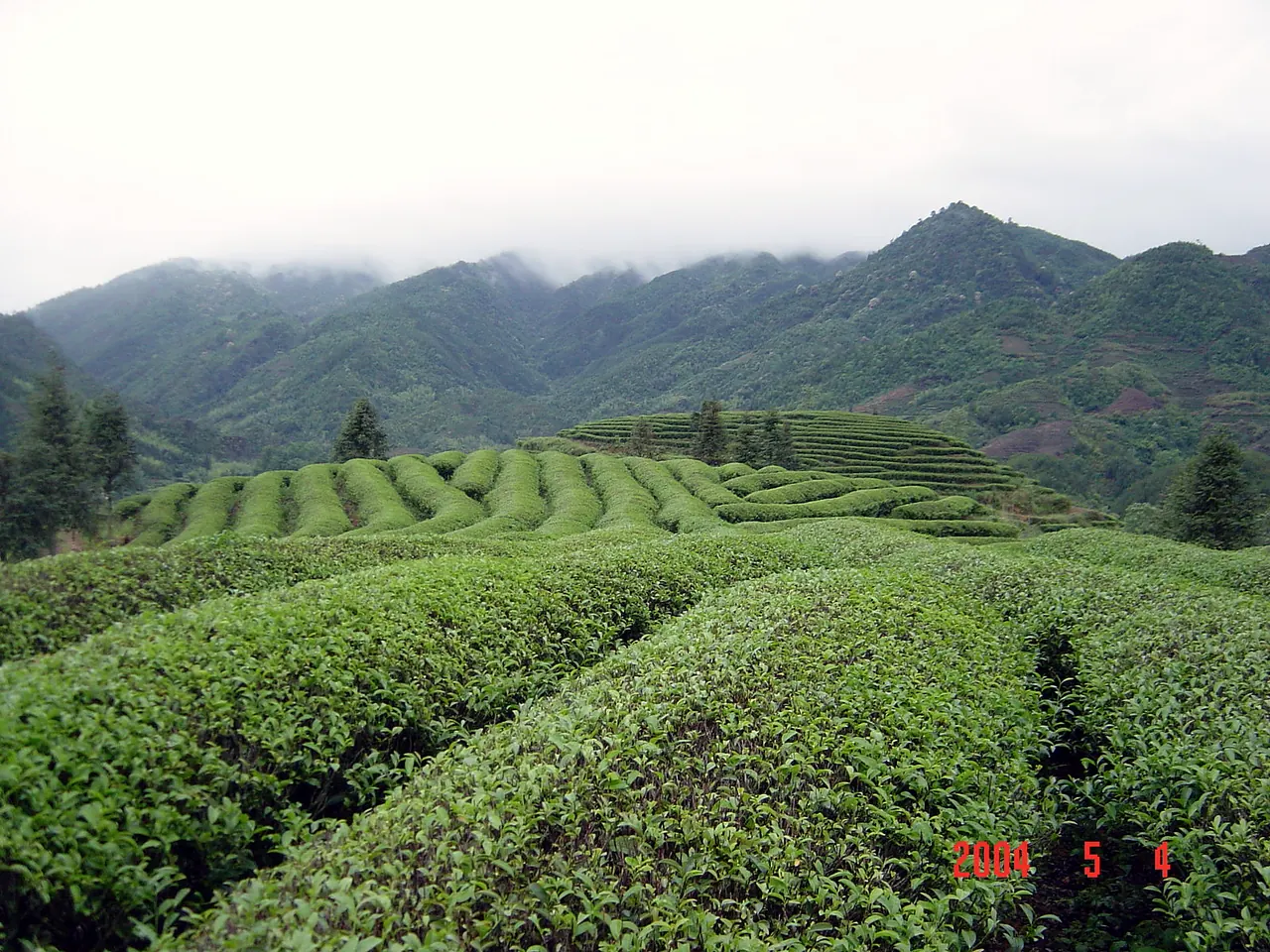
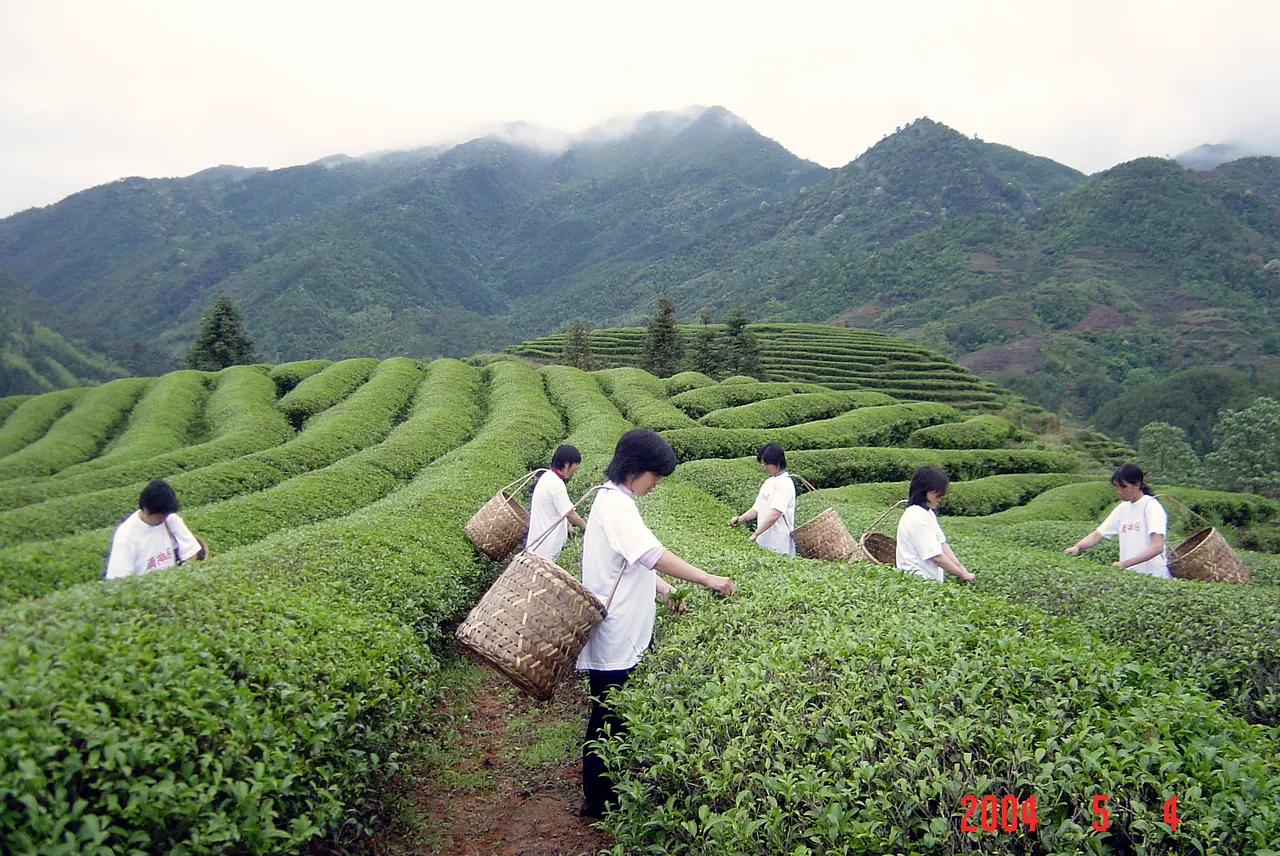
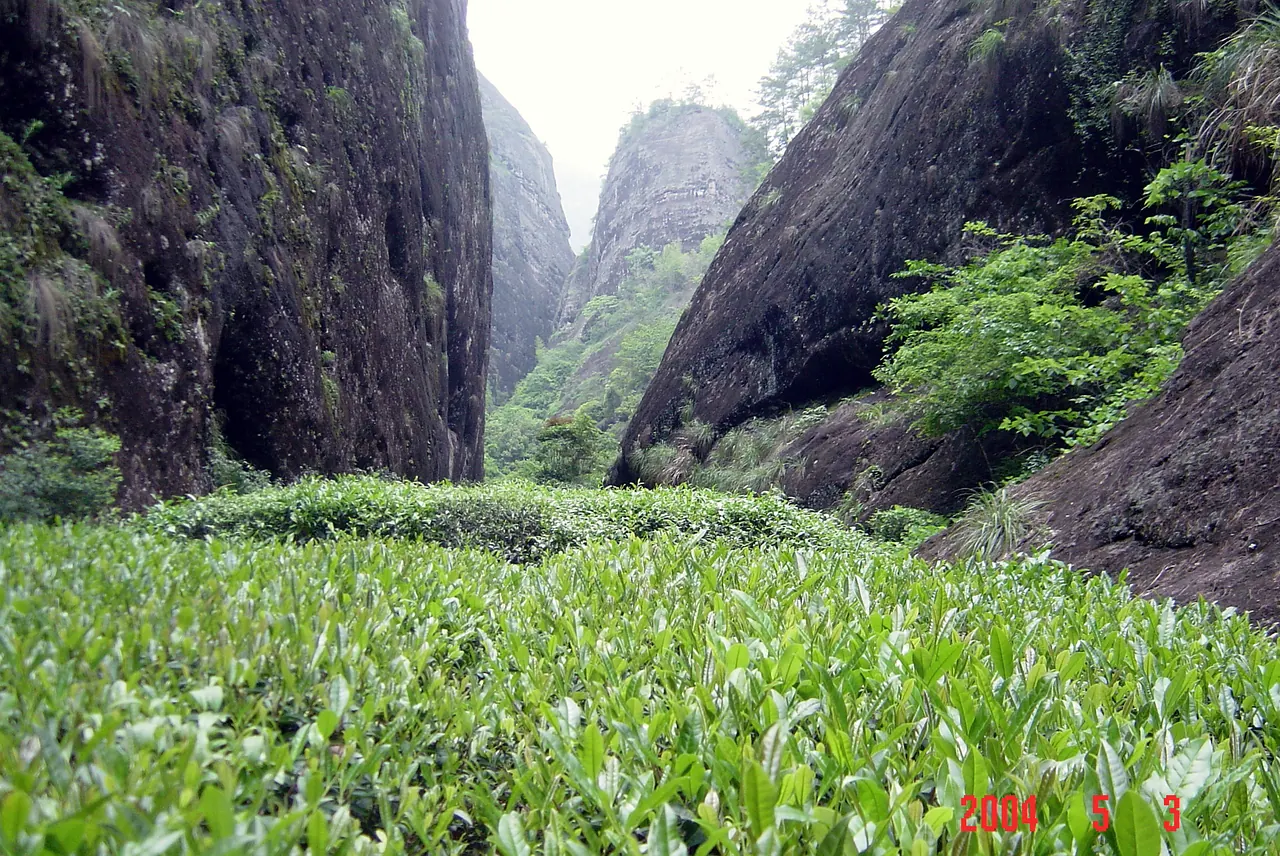
The same gardens, 2008.
Snapshots from our own photo archive, date stamps and all. Organic farming here is not new.
From our garden archive, 2008Picking in our garden, 2008Tea between the rocks, from our garden archive
What the laboratory found
Tested against EU limits.
In August 2026 we sent a sample of Rou Gui (lot 20260510) to Alex Stewart (Agriculture) China Ltd. for residue testing. The laboratory concluded that the tested parameters complied with the EU limits cited in its report, under Regulation (EC) No 396/2005 (report TS2631904, 30 August 2026).
One substance was detected: 2-phenylphenol at 0.036 mg/kg, below the 0.05 mg/kg limit stated in the report. We publish that number because accuracy matters more than a perfect-sounding claim.
Our organic certificates are issued under China's GB/T 19630-2019. We do not hold EU, USDA or JAS organic certification and do not use those marks.
A laboratory report describes the sample tested, not every tea or future lot. We do not describe our tea as "zero residue".
A tea carries organic status only if it falls within the scope of the certificates above. Ask us about any specific lot.
You can look up Chinese organic certificates by number on the CNCA certification information platform.
Questions
Organic, answered plainly.
Since when has Kings Tea been certified organic?
Since 30 September 2005. That first-issue date is printed on both of our current certificates. Our files hold every annual processing certificate from 2005 to 2024 — twenty in a row, each valid for one year — covering 30 September 2005 to 29 September 2025 without a gap.
Which certificates are current?
Garden certificate 096OP1200315 and processing certificate 096OP1200316, issued under GB/T 19630-2019 by Hangzhou Zhongnong Quality Certification Centre and valid from 30 September 2026 to 29 September 2027.
What exactly do the certificates cover?
The garden certificate covers fresh tea leaf from the Huanglongshan No. 1 garden, 10.53 hectares. The processing certificate covers Qingshenge-brand oolong tea (Wuyi rock tea) and black tea made at our factory. A tea is covered only if it falls within these scopes, so ask us which teas and lots are certified.
Is the tea certified organic in the EU, US or Japan?
No. Our certificates are issued under China's national organic standard. We do not hold EU, USDA or JAS organic certification, and we do not use those marks. An importer who needs one of those schemes should raise it with us at the start.
Is the tea free of pesticide residues?
We do not claim "zero residues". An EU-standard laboratory report on a Rou Gui sample (lot 20260510, 30 August 2026) found the tested parameters within the EU limits cited; one substance, 2-phenylphenol, was detected at 0.036 mg/kg against a limit of 0.05 mg/kg. Laboratory results apply only to the sample tested.
For tea shops, importers & tea clubs
Good tea begins with a conversation.
Tell us which teas you are looking for and where you are based. We will suggest what to taste and share the certificates and reports that apply to it.